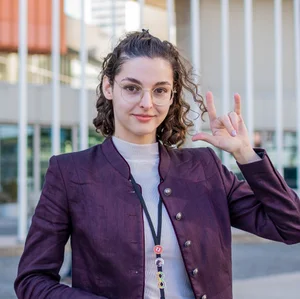
The History of Sign Language at the Eurovision Song Contest
Europe, shall we dance? In preparation for the Eurovision Song Contest (ESC), Vienna has been leaning into its livable city image, and a big part of this is accessibility.
As the ESC is produced by each country’s public broadcaster, they are already obligated to offer an accessible listening/viewing experience. This includes not only captions, but also international (or local) sign language translations, and audio descriptions.
A milestone in designing an accessible Song Contest was already achieved in Vienna 2015. At that time, participating acts were broadcast with music signing in International Sign Language for the first time. What was a premiere back then has since become standard. In 2026, ORF will again produce all songs with music signing and offer them to all participating broadcasters for transmission.
But sign translations do not describe them accurately. Instead of word-for-word interpretation, sign performances convey the energy and feelings in the song, matched to the beat. After all, there’s an immense difference between “yeah yeah fire” and a stage performance of Eleni Foureira’s Fuego.
Live interpretation from spoken to sign doesn’t always match the grammar used in sign language. For example, think of the difference between American Sign Language (ASL) and Signed Exact English (SEE).
In court interpreting, at official institutions, or in healthcare settings, exact interpreting is crucial. But music is about artistry.
Sign Performers at Vienna 2026
In January, ORF announced the casting call for sign performers. The call was open to members of the Deaf community (including people who are deaf, hard of hearing, or wearing a cochlear implant), who are experienced with artistic expression.
The jury included representatives from local D/deaf community: Ilona Seifert (WITAF), Sabine Klein (equalizent) and Helene Jarmer (ÖGLB). As well as Judith Weissenböck from the ORF’s regional studio for Vienna and Sabine Weber from the ORF television editorial department.
Eurovision’s 2026 sign performers are:
Alice Hu Xiaoshu (Shanghai/China), who already performed at the 2015 ESC in Vienna
Amanda Jovanovic (Vienna/Austria)
Anja Burghardt (Linz/Austria)
Carina Kilinc (Vienna/Austria)
David Obermaier aka silentbeat (Graz/Austria)
Julia Kulda Hroch (Berlin/Germany)
Together with performance coaches Magdalena Schramek and Delil Yilmaz, who led the casting, they created and recorded the visual interpretations of the contestant songs.
The finished song performances will be broadcasted in the Eurovision Song Contest live shows on ORF ON and ORF 2 Europe, the public viewing at the ESC village, and on the official YouTube channel. Last year, the videos with sign performances were unlisted and only discoverable through a playlist, so you may have to look through the playlist collection to find them.
ESC Sign Project in 2015
In an interview with local newspaper Der Standard, Alice Hu Xiaoshu (sign performer) and Delil Yilmaz (project lead) explained how they created fitting sign performances for ESC Vienna 2015:
First, they started by analyzing the lyrics and the themes of the songs. The interpreters recorded demo versions of the songs for the performers. Then the sign performers brought them to life with their personal, artistic style in international sign.
As said before, sign performances aren’t one-to-one translations of the lyrics, as it is usually the case for interpretation in parliament, court or appointments, where accuracy is key. Delil Yilmaz emphasises that while the accuracy of the information relayed is the responsibility of every interpreter, this key point plays a lesser role in music because it is an art form. For instrumental breaks, there is no direct translation.
Instead, the team turned sounds into stories. For example, for love songs, to set the mood, they would introduce a person waiting for their significant other, and as they appear, the lyrics take over.
For the rhythm, they used subwoofers (strong bass or sub-bass loudspeakers designed to amplify low-pitched frequencies, not to be confused with Subwoolfer, the Norwegian 2022 ESC act). High-energy songs were embodied with more energetic movements in the upper body.